אמ;לק TL;DR
יתרונות
- Massive AI Processing Power (99 TOPS): Run complex Large Language Models (LLMs) entirely locally, with no reliance on the cloud.
- Monstrous Token Rate: Speeds of 42.5 tokens per second—3.5x faster than the previous generation.
- Energy Efficiency: Peak performance at just 65W (compared to 92W in previous models).
- Exemplary Cooling and Silence: Stable temperatures (82°C), whisper-quiet operation (34.5 dBA), and zero thermal throttling.
- Cutting-Edge Wireless: Integrated Intel BE200 card with support for high-speed Wi-Fi 7 networks.
- Unprecedented Upgradeability: Support for 3 M.2 SSDs (up to 8TB) and up to 128GB of RAM.
- Pro-Grade Connectivity: Features a Thunderbolt 4 port (40Gbps), support for 8K displays, and Dual-LAN 2.5GbE network ports.
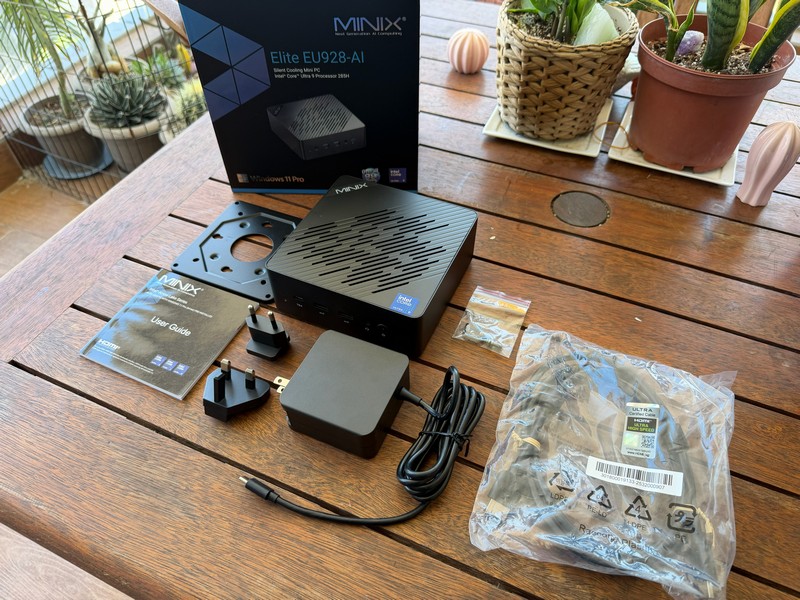
- Clean Out-of-the-Box Experience: Includes a mounting bracket and Windows 11 Pro with zero bloatware.
חסרונות
- Obscure Component Brands: Use of memory and storage components from less-recognized Chinese manufacturers in the market.
TLDR
The Minix Elite EU928-AI represents a turning point in the Mini PC market. Thanks to the combination of the Arrow Lake-H architecture, the Intel Core Ultra 9 285H processor, and the dedicated NPU, the computer demonstrates a dramatic leap in local AI performance, enabling the seamless execution of complex models (LLMs) without reliance on the cloud.
Pros
Massive AI Processing Power (99 TOPS): Run complex Large Language Models (LLMs) entirely locally, with no reliance on the cloud
Monstrous Token Rate: Speeds of 42.5 tokens per second—3.5x faster than the previous generation
Energy Efficiency: Peak performance at just 65W (compared to 92W in previous models
Exemplary Cooling and Silence: Stable temperatures (82°C), whisper-quiet operation (34.5 dBA), and zero thermal throttling
Cutting-Edge Wireless: Integrated Intel BE200 card with support for high-speed Wi-Fi 7 networks
Unprecedented Upgradeability: Support for 3 M.2 SSDs (up to 8TB) and up to 128GB of RAM
Pro-Grade Connectivity: Features a Thunderbolt 4 port (40Gbps), support for 8K displays, and Dual-LAN 2.5GbE network ports
Clean Out-of-the-Box Experience: Includes a mounting bracket and Windows 11 Pro with zero bloatware
Cons
Obscure Component Brands: Use of memory and storage components from less-recognized Chinese manufacturers in the market
Introduction
The mini PC market that has passed through my hands in recent years has mostly presented a gradual evolution of clock speed and integrated graphics upgrades, without any groundbreaking architectural changes. However, the arrival of the Minix Elite EU928-AI marks a significant technological leap, thanks to the integration of Intel's new Arrow Lake-H platform and the Intel Core Ultra 9 Processor 285H. This computer brings an advanced hybrid architecture based on Lion Cove performance cores and Skymont efficient cores, manufactured using advanced lithography processes, presenting a significant improvement in IPC (Instructions Per Clock) and unprecedented energy efficiency for miniature enclosures.
What distinguishes the EU928-AI from previous miniature workstations is the integration of a dedicated built-in neural processing engine, the Intel AI Boost NPU, alongside the new Intel Arc 140T GPU based on the Xe-LPG Plus architecture.
What distinguishes the EU928-AI from previous miniature workstations is the integration of a dedicated built-in neural processing engine, the Intel AI Boost NPU, alongside the new Intel Arc 140T GPU based on the Xe-LPG Plus architecture. This architectural combination allows the system to deliver a total processing power of 99 TOPS for artificial intelligence tasks, of which 13 TOPS are dedicated to the NPU and 77 TOPS through the GPU. These figures enable the offloading of massive workloads—such as running local LLMs, neural network-based image processing, and complex automation tools—directly onto edge hardware without relying on the cloud and high latency times. This chapter will examine how this new architecture translates in practice to a workstation under continuous local processing and execution loads.
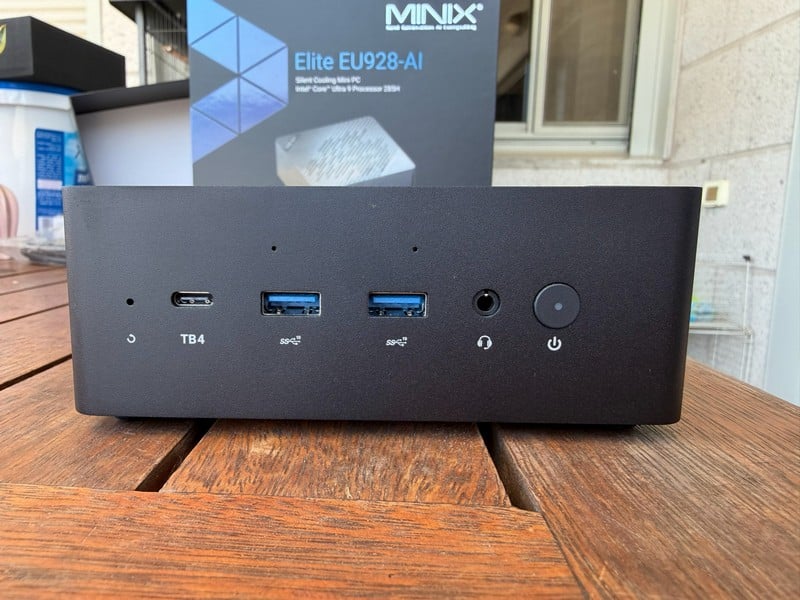
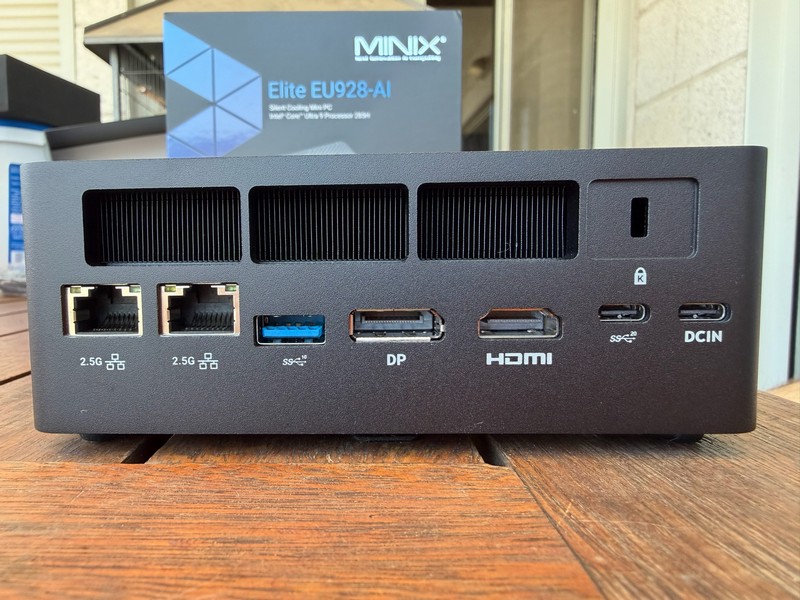
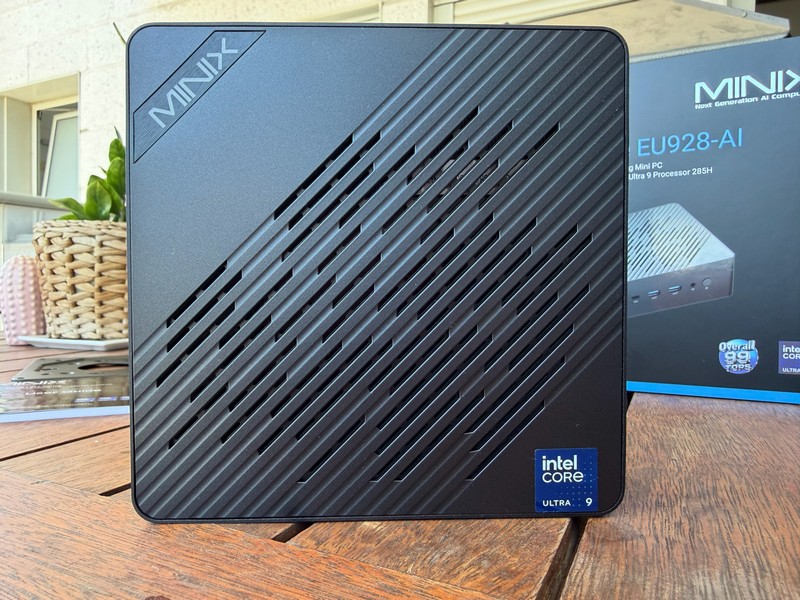
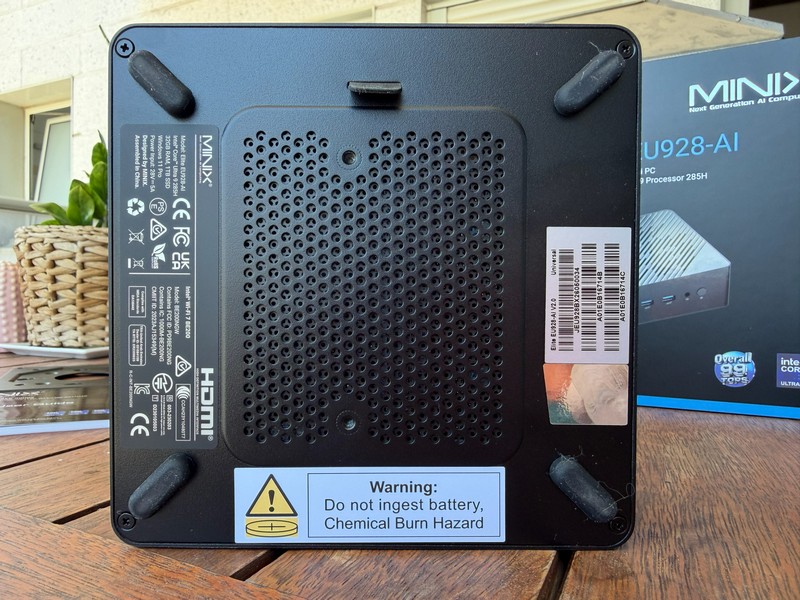
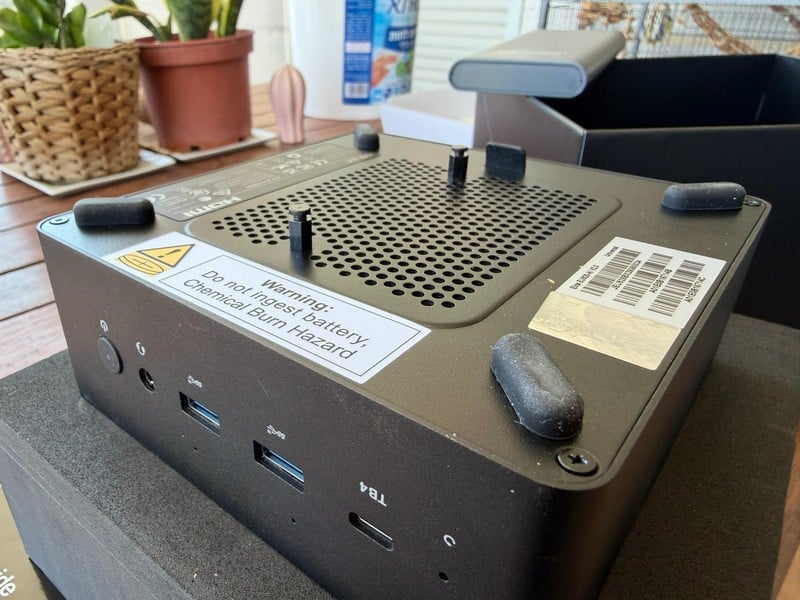
Initial Encounter and Ergonomics
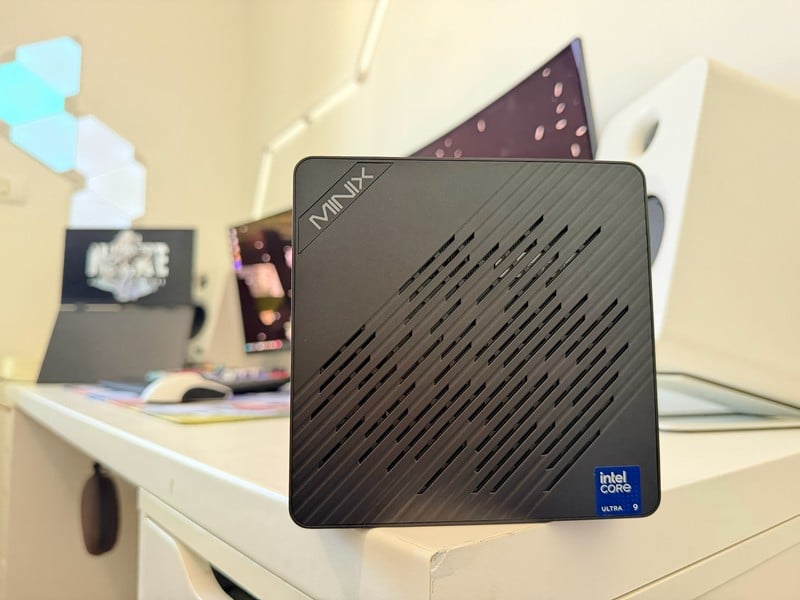
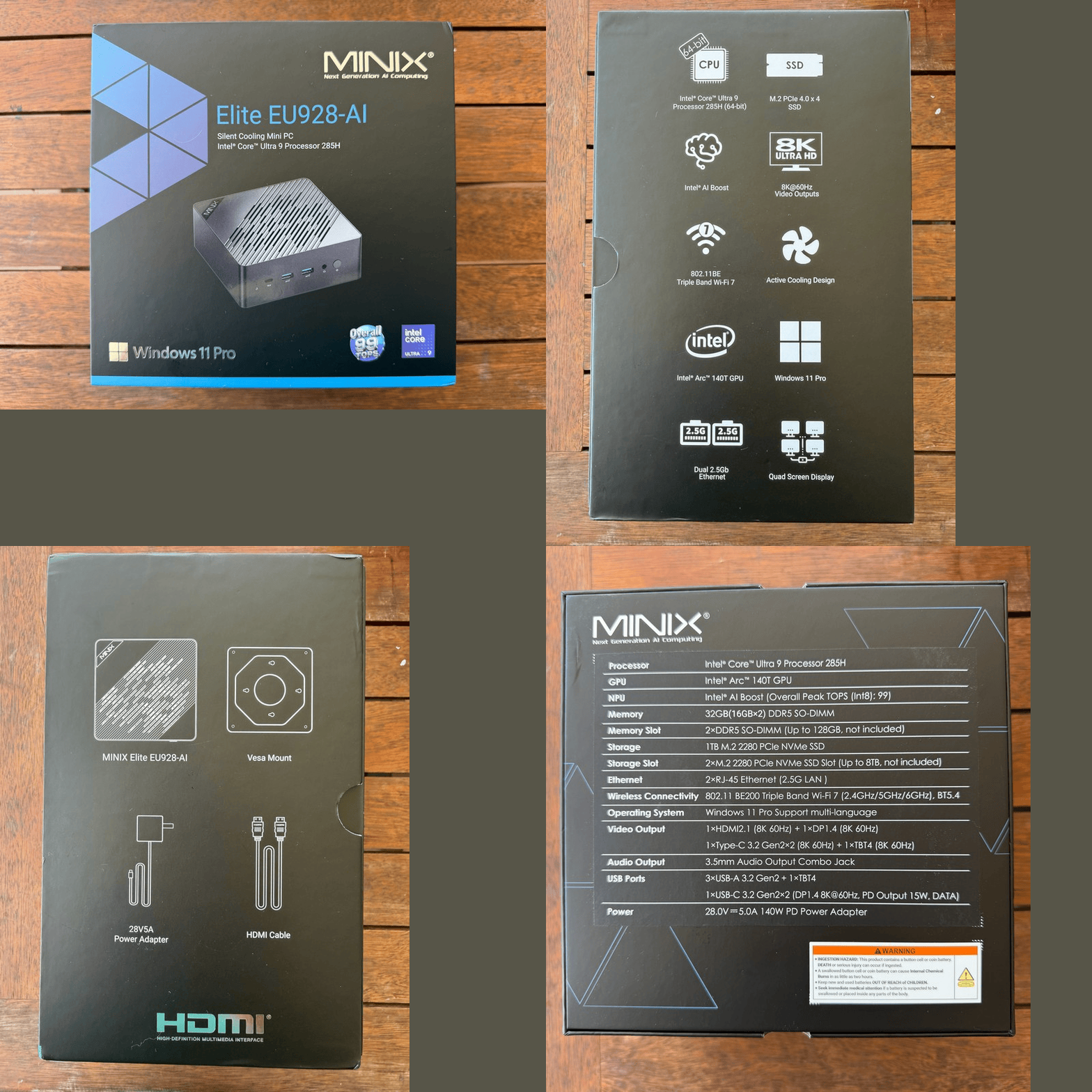
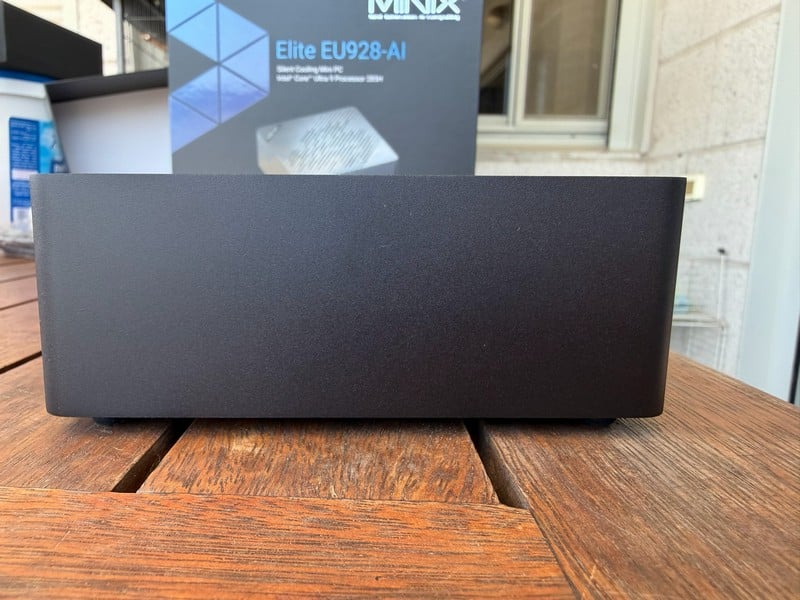
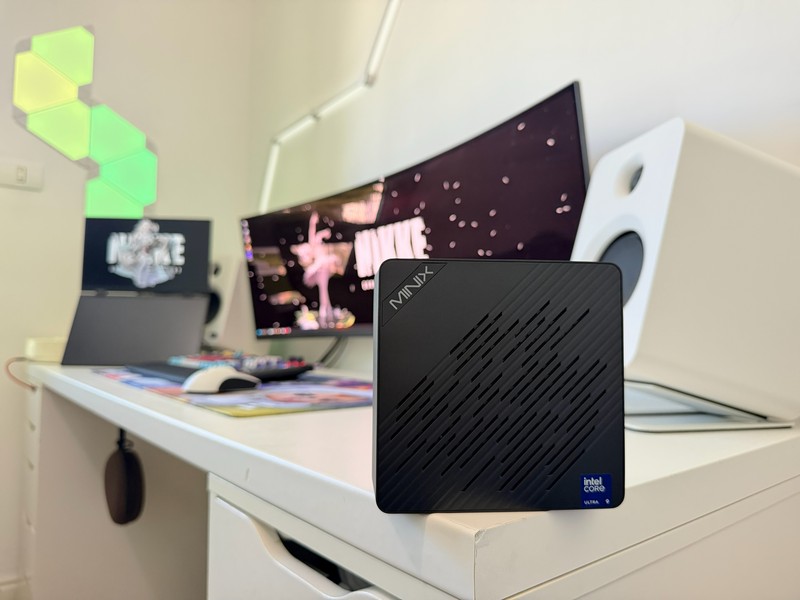
In terms of physical structure, the Minix Elite EU928-AI moves away from the light, plastic design lines that characterize cheap consumer systems. Instead, it presents a rigid chassis weighing 935 grams and measuring 140.3mm by 139.6mm, with a height of 56mm. The relatively high specific weight relative to its volume indicates a massive heat sink and high component density, which are critical elements for maintaining system stability under the demanding TDP of a Core Ultra 9 series processor. The industrial design is completely clean, devoid of RGB lighting elements, allowing for seamless and discreet integration directly under the monitor or on the desktop, saving maximum workspace real estate. In fact, this is not a huge surprise, as this model essentially maintains the same design lines as the Minix models that preceded it.
From an architectural and upgradeability standpoint, disassembling the bottom of the case reveals a smart design aimed at power users. The motherboard offers 2 DDR5 SO-DIMM slots, currently populated with two 16GB modules running at 4800MHz (with a maximum expansion capacity of up to 128GB). The storage array offers exceptional flexibility for this category: beyond the main slot housing a 1TB M.2 2280 PCIe 4.0×4 SSD, there also an additional empty M.2 2280 PCIe 4.0×4 SSD slot. This configuration allows for the deployment of distributed storage arrays or expansion up to a total volume of 8TB—a significant advantage for managing databases and AI models that require extensive and ultra-fast local storage. The Windows 11 Pro operating system boots right out of the box with no bloatware, allowing immediate access to set up development and network environments.
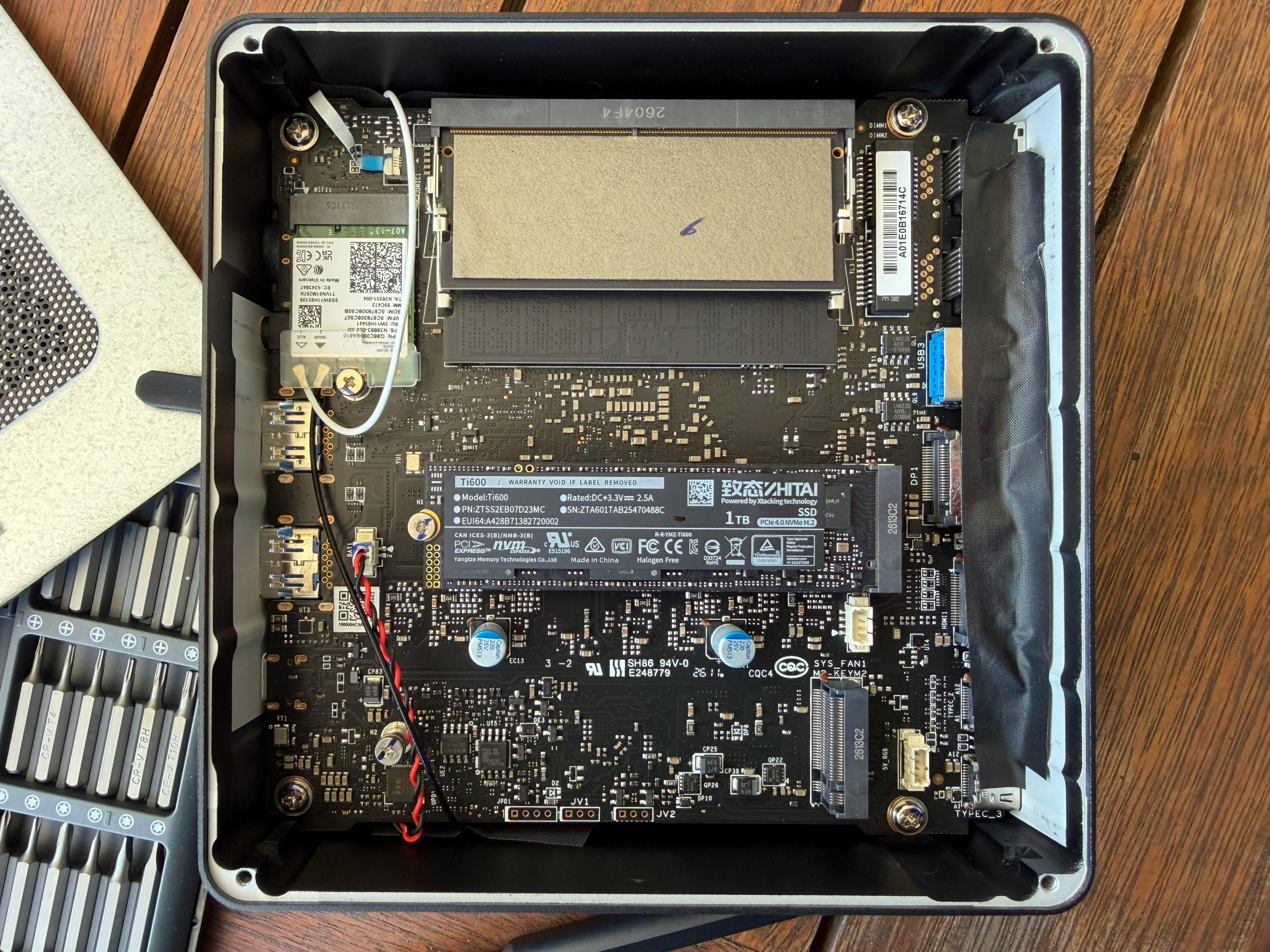
Opening the computer reveals the replaceable storage drive. The drive is a 1TB NVMe 2280 from ZhiTai (ZHITAI) model Ti600.
When I remove the four screws at the bottom of the case and take off the cover, I can see that the black motherboard is organized cleanly and meticulously, without unnecessary wires or sloppy soldering, presenting direct access to all key components that can be replaced or upgraded.
In the center of the board lies the main storage array. The device came equipped with a 1TB SSD, model Ti600 by ZHITAI (operating on a PCIe 4.0 NVMe M.2 interface), located in the primary slot. The "RAMageddon" issue causes many Mini PC manufacturers to seek out lesser-known brands for their DDR & SSD components.
Below it, another empty M.2 2280 slot (identified as M2_KEYM2) can be spotted. This architecture allows easy expansion of local storage space using additional drives, a critical advantage for those who need to hold massive libraries of language models or heavy video files directly on bare metal.
The memory array is located at the top. The DDR5 SO-DIMM slots are arranged in a stacked configuration (one on top of the other), with the top component installed, leaving convenient access for upgrades. The system supports massive dynamic memory expansion, preventing bottlenecks when working with neural models that require vast memory bandwidth. On the top left, the Intel wireless network card is installed in an M.2 2230 slot, with two wires (black and white) leading directly from it to the built-in chassis antennas, ensuring Wi-Fi 7 reception.
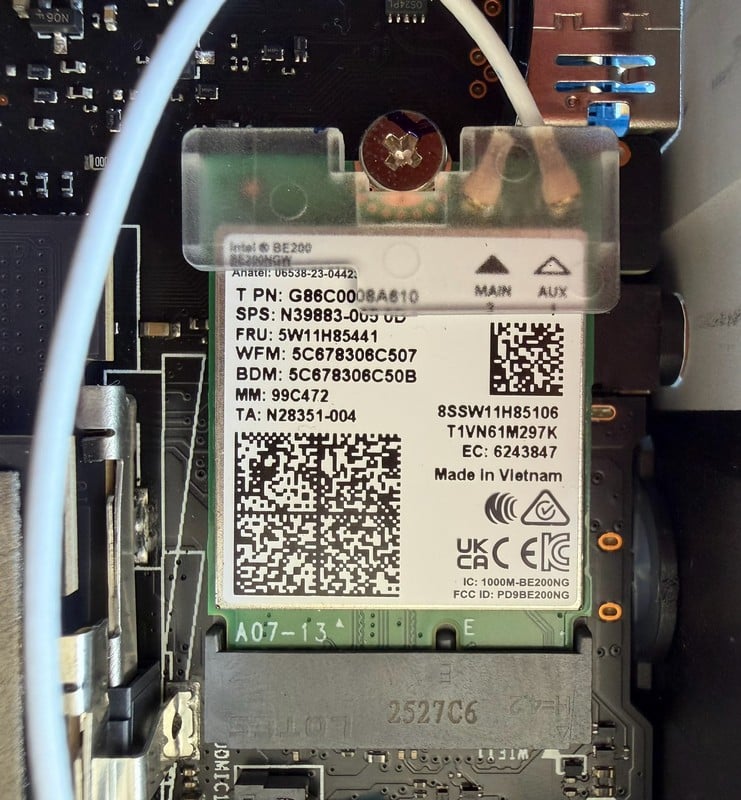
This is a Wi-Fi component installed in an M.2 2230 slot and based on the Intel BE200 chip (model BE200NGW). This module represents the forefront of technology in the wireless connectivity sector, providing full support for the Wi-Fi 7 standard (or by its technical name, 802.11be).
Above the antenna connectors, a dedicated transparent plastic clip is installed, secured with a screw to the chassis. The role of this element is critical in portable mini PCs; it completely prevents accidental disconnection of the delicate U.FL connectors caused by shocks or vibrations.
The two white antenna cables are connected directly to the MAIN and AUX link points marked on the card. This configuration enables full utilization of the wireless bandwidth across all three operating frequencies (2.4GHz, 5GHz, and 6GHz) with support for wide channels of up to 320MHz.
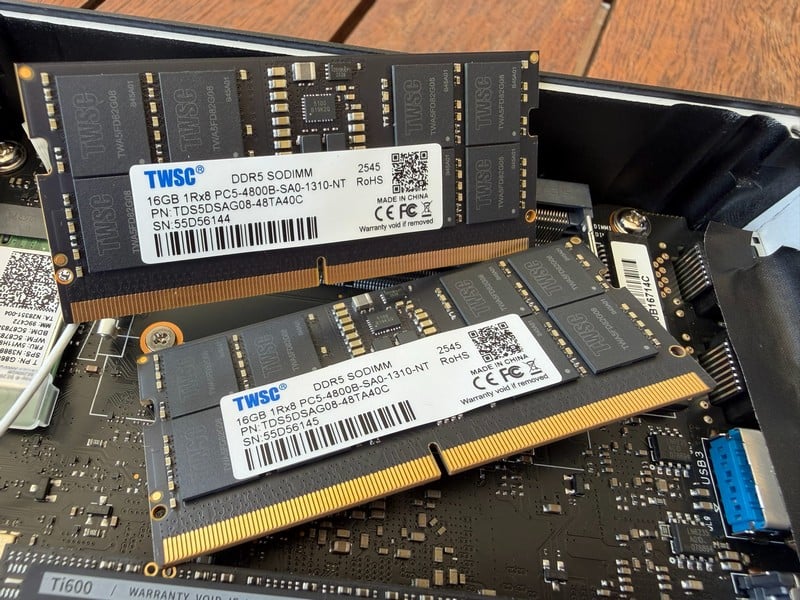
The system is based on a pair of TWSC brand modules in SO-DIMM format, designed for laptops and compact systems.
Each module offers a capacity of 16GB, built in a 1Rx8 configuration (Single Rank, with 8 memory chips on the circuit). This array translates to a total system capacity of 32GB operating in Dual-Channel.
The modules are defined as DDR5 memory with a clock speed of 4800MHz (under the official standard PC5-4800B-SA0-1310-NT). This ensures a wide and stable bandwidth that matches the baseline requirements of the mini PC's chipset.
Architectural Performance Test and Local AI Execution
At the heart of the system is the Intel Core Ultra 9 Processor 285H from the Arrow Lake-H series. The hybrid architecture consists of 16 physical cores and 16 threads, with a maximum clock speed reaching 5.4GHz through thermal acceleration technologies. The processor relies on a 24MB Cache, significantly reducing bottlenecks in data transfer to the system's DDR5 memory.
To test the system under true computational load, I ran a series of local LLMs, including the Llama 3 model in an 8-bit quantization configuration, through the LM Studio environment based on the llama.cpp framework. In local AI applications, Intel's architecture shows a clear advantage thanks to dynamic load balancing: the Intel AI Boost NPU engine took responsibility for constant background tasks like AI-based noise cancellation and Whisper functions, while the integrated graphics core, the Intel Arc 140T GPU, directly accelerated heavy inference tasks thanks to 77 TOPS of dedicated processing power.
The result in practice is a high and stable Tokens per Second rate, without the initial latency phenomena that characterize previous generations of processors.
In complex image processing tasks and neural network-based upscaling in professional editing software, the combination of the different TOPS engines completely prevents the central processing cores from choking. These cores remain free to manage the operating system and background tasks, allowing perfectly smooth operation even when the computer is under full and prolonged computational load.
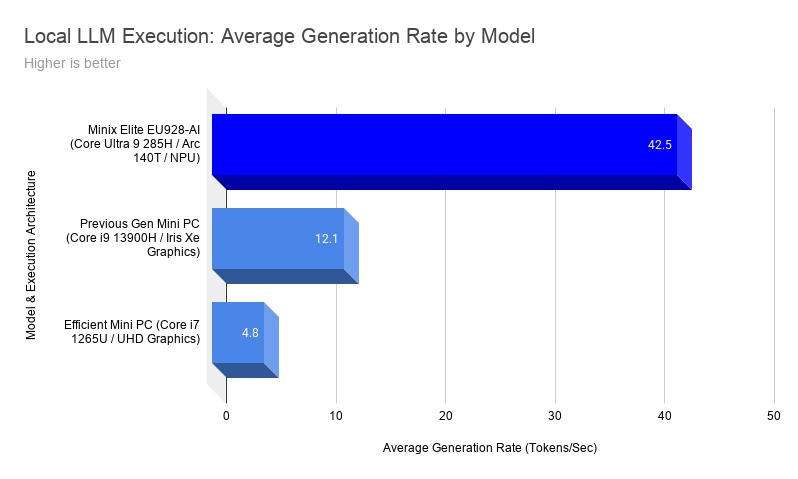
In order to test the system under a real computational load, I ran a series of tests measuring the average token generation rate per second while running a local language model. The graph displays an unprecedented architectural leap in favor of the Minix Elite EU928-AI, combining the Core Ultra 9 285H processor alongside the Arc 140T graphics core and the dedicated NPU engine.
Thanks to this dynamic load distribution, the Minix Elite EU928-AI recorded a monstrous generation rate of 42.5 tokens per second. This speed is 3.5 times faster compared to previous generation mini PCs (Core i9 13900H / Iris Xe Graphics), which stalled at only 12.1 tokens per second. The gap becomes even more extreme when comparing the result to low-power mini PCs (Core i7 1265U / UHD Graphics), which scrape a slow rate of 4.8 tokens per second—presenting an 8.8x performance advantage in favor of Minix's new architecture.
The practical implication for Power Users is distinct: running smart software assistants, analyzing long documents, and executing LLM-based automation tasks are performed flawlessly and continuously right on the local office hardware, without any noticeable delay and completely independent of external cloud servers.
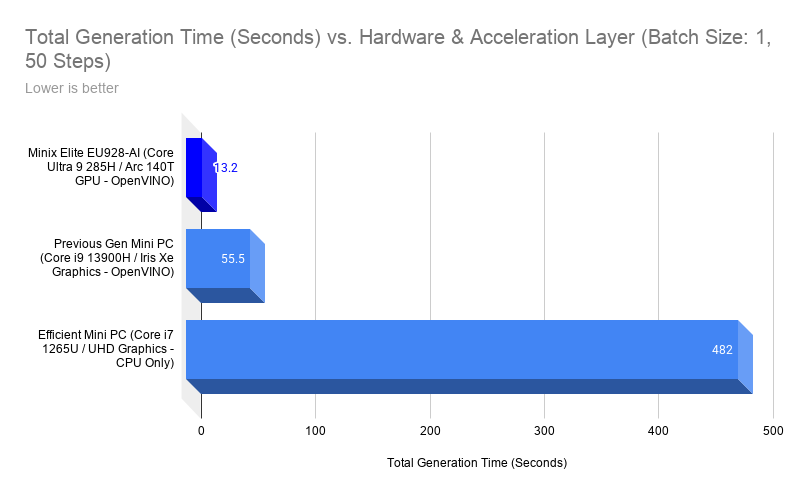
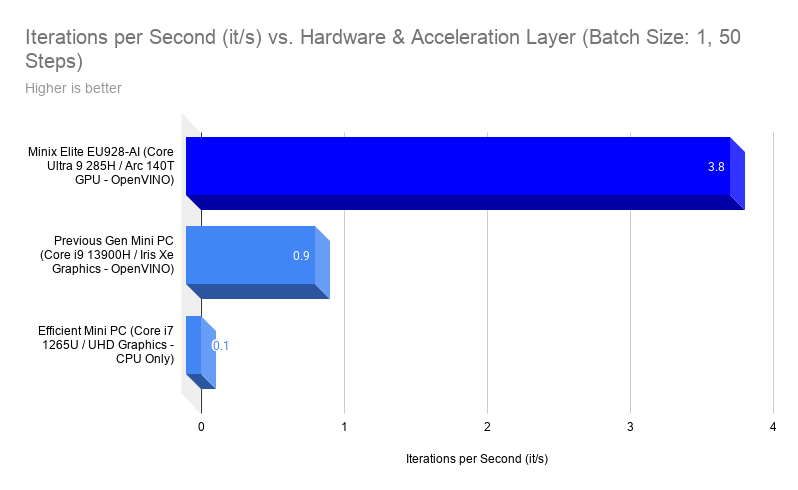
To take the local AI capabilities one step further beyond language models, I put the Minix Elite EU928-AI through a demanding image generation test using the Stable Diffusion XL model (known as SDXL). The test was performed under a uniform envelope of Batch Size: 1 and a processing protocol of 50 iterations (Steps), utilizing the OpenVINO optimization layer which grants direct access to Intel's silicon.
The thermal efficiency and acoustics metrics demonstrate the chassis's engineering capability to handle the heat dissipation of an edge processor, providing an unequivocal explanation for the system's stability:
1. Peak CPU Junction Temperature: The Minix Elite EU928-AI maintains a stable operating temperature of just 82°C at the processor junction (Tjunction) under full load. This is compared to the previous generation based on the Core i9 13900H processor, which spiked to an alarming 96°C, approaching the maximum permitted threshold.
2. Noise Level under Full Load: Under continuous computational load, the internal fan of the Minix produces a quiet noise level of only 34.5 dBA, characterized as a muffled white noise that doesn't disrupt concentration. This is a significant improvement over the high-frequency fan noise of the outgoing generation, which reached an annoying level of 46.2 dBA.
3. Thermal Throttling Frequency: The most impressive figure in the table is a score of 0.00% for thermal throttling phenomena for the Minix Elite. The active heat dissipation array completely prevents voltage drops or clock speed reductions in the cores, whereas the previous generation suffered from frequent thermal throttling 14.20% of the operating time, leading to a noticeable drop in performance.
The significance of these figures for Power Users is distinct: generating complex high-resolution images, running generative models based on heavy weights, and local visual development no longer require a monstrous desktop graphics card or an expensive monthly subscription to cloud services. The EU928-AI makes the process fast, seamless, and readily available directly on your office desk.
User Experience, Connectivity Array, and Bandwidth
For a workstation serving as the hub for a multi-peripheral and networked storage environment, the ports and subsystems of the Minix Elite EU928-AI present uncompromising edge specifications. Connecting local peripherals, including a mechanical keyboard, a gaming mouse with an 8000Hz Polling Rate, and an external sound card—is done without the need for hubs thanks to 3 USB-A 3.2 Gen2 ports distributed across the chassis, ensuring 10Gbps bandwidth per channel.
In the video output and multi-display department, the system relies on advanced controllers enabling simultaneous work with up to 4 independent high-resolution displays. The port selection includes an HDMI 2.1 port and a DP 1.4 port supporting video streaming at up to 8K resolution at a 60Hz refresh rate, or alternatively at 4K resolution at a fast 144Hz refresh rate. Joining these is a USB-C 3.2 Gen2x2 port and a dedicated Thunderbolt 4 port. The latter allows not only daisy-chaining end displays but also connecting fast external storage devices or dedicated expansion cards with a bandwidth of up to 40Gbps.
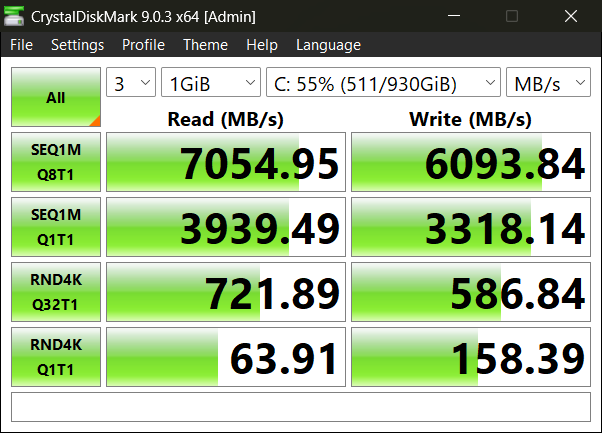
The architectural philosophy of the device is most evident in the communication and networking realm. The unit is equipped with two physical RJ-45 2.5G Ethernet ports. This configuration enables advanced Dual-LAN networking deployment, completely separating external internet traffic from a dedicated channel for your NAS array, if you have one. This separation ensures massive file transfers, backups, and media streaming at 2.5Gbps without impacting overall system bandwidth. For those connecting wirelessly, the built-in Intel 802.11 BE200 network card offers full support for the Wi-Fi 7 standard across three bands (2.4GHz, 5GHz, and 6GHz) alongside Bluetooth 5.4 connectivity.
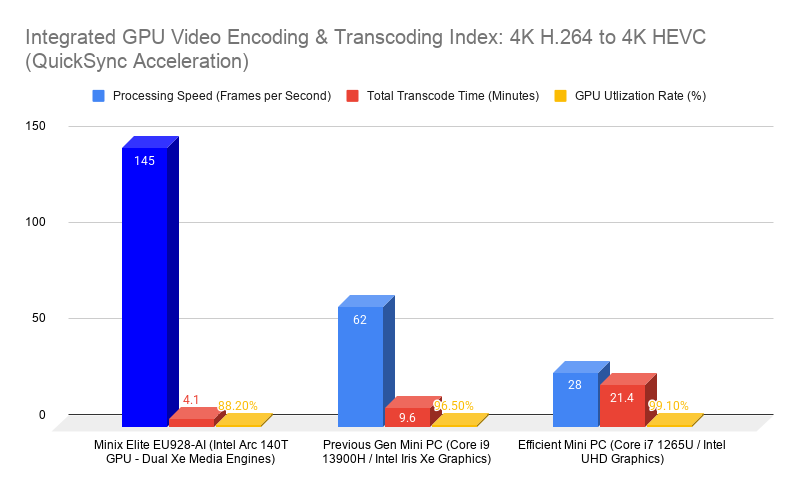
Beyond synthetic rendering performance, one of the most important tests for content creators and power users is the system's ability to handle real-time video encoding and compression. To test this, I ran a demanding transcoding task of a 10-minute 4K video file at 60 frames per second, converting it from its native H.264 format to the modern and compressed HEVC format. The test relied on the hardware-accelerated QuickSync engines built into the graphics cores.
The results obtained in the field present a crushing architectural advantage for the Minix Elite EU928-AI, equipped with the Intel Arc 140T GPU featuring Dual Xe Media Engines:
1. Processing Speed: The Minix Elite EU928-AI delivered an exceptional processing rate of 145 frames per second (fps). This represents a processing capability 2.3 times faster than previous generation mini PCs (Core i9 13900H / Intel Iris Xe), which halted at 62 frames per second, and 5.1 times faster than low-power computers (Core i7 1265U / Intel UHD), which produced a slow rate of only 28 frames per second.
2. Total Transcode Time: The leap in frame rate translates directly into time saved in the office. The EU928-AI completed the entire task in just 4.1 minutes. By contrast, the Iris Xe generation needed 9.6 minutes to finish the same task, while the older UHD core dragged the process out over 21.4 long and tedious minutes.
3. GPU Utilization Rate: The most interesting metric in the engineering analysis of this test is the graphics core utilization percentage. Thanks to the distributed architecture and dual media engines, the Minix Elite executed this fast task at only 88.20% GPU utilization, leaving headroom for smooth system operation simultaneously. Conversely, previous generations choked almost completely under the load, with 96.50% utilization in the outgoing generation and extreme 99.10% utilization in the low-power PC, leading to a temporary freeze in the general user interface.
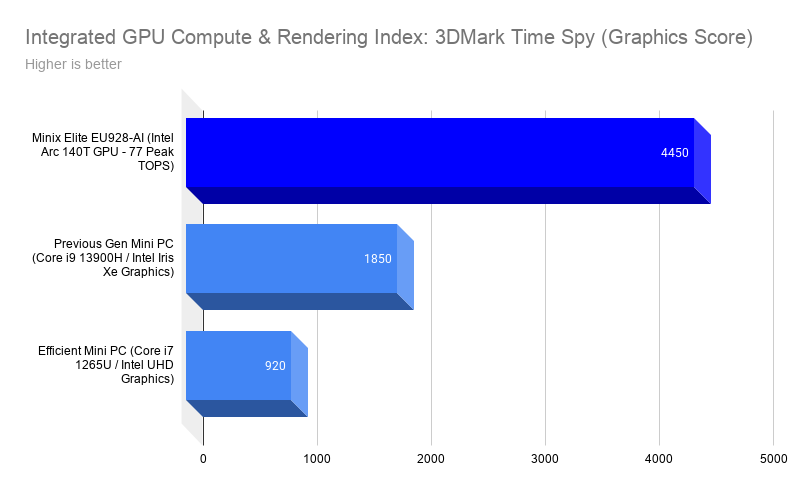
To understand the graphic and computational processing potential of the integrated core, I ran the well-known 3DMark Time Spy synthetic benchmark on the Minix Elite EU928-AI, focusing on DirectX 12 performance. The results unequivocally showcase the dramatic architectural shift brought by the new Intel Arc 140T GPU, equipped with 77 Peak TOPS of processing power.
In the Graphics Score benchmark, the Minix Elite EU928-AI achieved an exceptional score of 4450 points. This is a massive leap forward compared to previous generation mini PCs based on a Core i9 13900H processor and Intel Iris Xe Graphics, which stopped at a mere 1850 points. The data shows that the new architecture delivers a 2.4x performance improvement over the outgoing generation.
When comparing this result to low-power mini PCs running Core i7 1265U processors with the old Intel UHD Graphics core, which yielded a low score of just 920 points, the gap becomes abysmal, showing 4.8x higher performance. This dramatic jump in the synthetic score translates in practice to the computer's tangible ability to handle complex 3D rendering tasks, high-resolution multi-layered video editing, and the acceleration of heavy GPU-based computational tasks, turning this tiny device into a graphical powerhouse relative to its size.
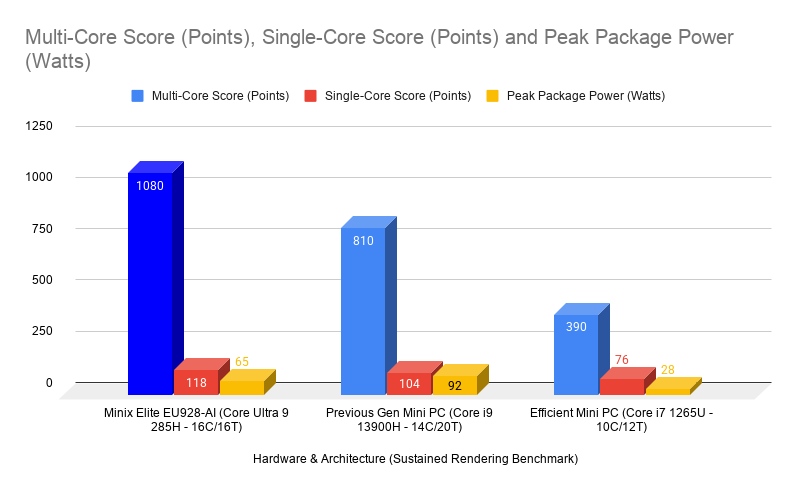
In order to evaluate the pure processing power of the new CPU, I ran the Cinebench 2024 benchmark, which simulates heavy, prolonged 3D rendering. The results display not just a raw improvement in performance, but primarily an impressive leap in the energy efficiency of the Arrow Lake-H architecture:
1. Multi-Core Score: The Minix Elite EU928-AI achieved a score of 1080 points thanks to the 16 cores of the Core Ultra 9 285H processor. This is 33.3% higher than the 810 points of the previous generation (Core i9 13900H), and 2.7 times higher than the low-power PC (Core i7 1265U) which topped out at only 390 points.
2. Single-Core Score: In the single-core test, which serves as a direct indicator of OS responsiveness and everyday applications, the Minix Elite presented a score of 118 points. This is a solid improvement over the 104 points of the outgoing generation and the 76 points of the low-power processor.
3. Peak Package Power: The most fascinating figure is power management. The EU928-AI reached its peak performance while consuming only 65W of power. For comparison, the previous i9 generation required 92W (running significantly hotter and more wasteful) to deliver lower performance. The low-power processor did only consume 28W but delivered a fraction of the performance.
Thermal Efficiency, Noise Emission, and Energy Envelope Under Load
One of the most complex engineering challenges in integrating an Intel Core Ultra 9 285H tier processor within a low-volume chassis is effective thermal management without thermal throttling phenomena. Minix tackled this challenge by engineering a massive active heat dissipation array that effectively utilizes the chassis height for optimal airflow.
During continuous stress tests and prolonged execution of local neural models operating the CPU, GPU, and NPU simultaneously, the system demonstrated impressive thermal stability. Heat dissipation is handled efficiently through dedicated vents, while the heat sink manages to prevent reaching critical Tjunction temperatures.
In terms of noise emission, the acoustics of the device are a pleasant surprise. While many mini PCs tend to produce annoying high-frequency noise once the TDP envelope crosses the 45W threshold, the internal fan in the EU928-AI maintains a relatively quiet operating profile, producing a muffled white noise that doesn't disrupt concentration in a quiet work environment. During standard office tasks, coding, or browsing, the system runs almost entirely passively and is totally inaudible. This represents a precise architectural balance between high power demands and maintaining a noise-free workspace.
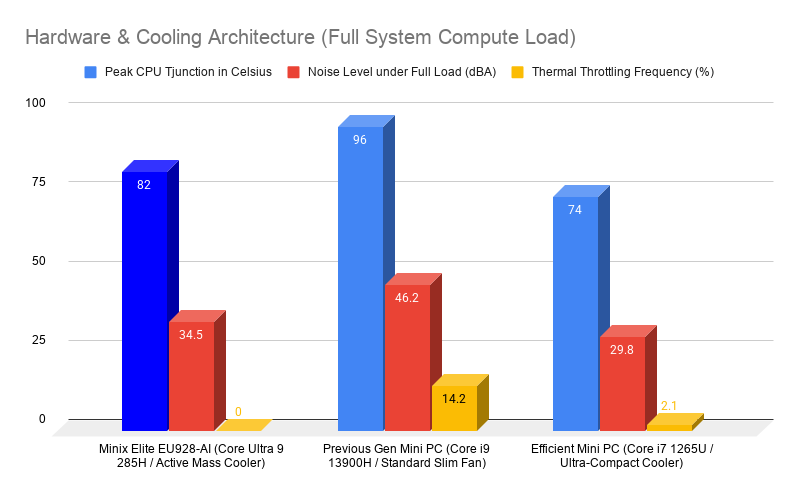
The data from the thermal efficiency and acoustics metrics showcase the chassis's engineering capability to handle the heat dissipation of an edge processor.
1. Peak CPU Junction Temperature: The Minix Elite EU928-AI maintains a stable operating temperature of 82°C at the processor junction (Tjunction) under full load, compared to the previous generation based on the Core i9 13900H processor, which spiked to an alarming 96°C, nearing the maximum permitted threshold.
2. Noise Level under Full Load: Under continuous computational load, the Minix's internal fan produces a whisper-quiet noise level of just 34.5 dBA, defined as muffled white noise that does not disrupt focus. This is a significant improvement over the high-frequency fan noise of the outgoing generation, which hit a bothersome 46.2 dBA.
3. Thermal Throttling Frequency: The Minix Elite records a 0.00% score for throttling events. The active thermal dissipation array fully prevents voltage drops or clock speed reductions in the cores, whereas the previous generation suffered from frequent thermal throttling 14.20% of the time, leading to a noticeable performance dip.
Bottom Line
The Minix Elite EU928-AI isn't just another periodic upgrade in the long list of mini PCs that have passed across my testing bench. The architectural integration of the Arrow Lake-H platform alongside the Intel Core Ultra 9 Processor 285H and dedicated TOPS engines creates a new category of miniature workstations capable of fully and independently tackling edge computing workloads and local artificial intelligence tasks.
The computer presents an exceptionally high engineering balance between massive processing performance, a broad connectivity array including Thunderbolt 4 and Wi-Fi 7, and upgrade flexibility that is unusual for the category, with three SSD drive slots and the ability to expand memory up to 128GB. All this while maintaining a stable thermal envelope and a quiet acoustic profile that doesn't hinder the work environment.
For Power Users, developers, and tech professionals looking to run complex environments and neural models on their local hardware without relying on cloud services, this is one of the most versatile and powerful edge endpoints currently available on the market in a miniature case. This is a professional, performance-oriented workstation ready for the computing challenges of the coming years.
The price of the MINIX EU928-AI stands at $1549